> ## Documentation Index
> Fetch the complete documentation index at: https://rag-docs.peakfs.io/llms.txt
> Use this file to discover all available pages before exploring further.
# Introduction
> How we utilize RAG at Peak Innovations
 ## Brief Overview
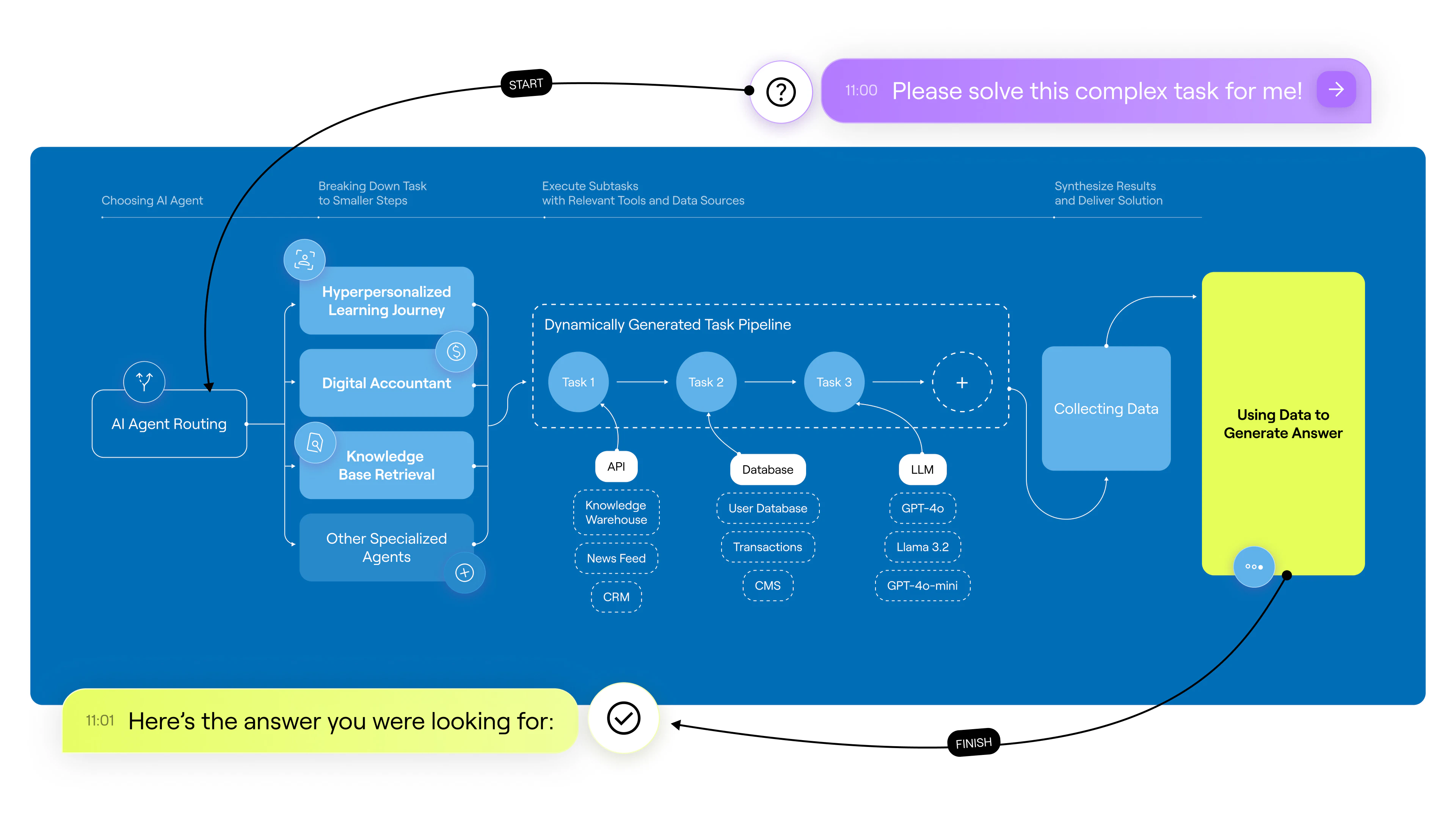
The RAG (Retrieval-Augmented Generation) framework at Peak Innovations is a versatile AI system that processes complex queries by dynamically selecting agents, breaking down tasks, and retrieving information from multiple sources.
Requests can range from real-time user queries to backend tasks, like generating customized learning materials.
## How it works
The system directs each request to the most appropriate AI agent, configured
to handle specific tasks such as financial analysis, knowledge retrieval, or
personalized learning.
The chosen agent break down the task and constructs a sequence of subtasks,
forming a dynamic pipeline. These subtasks are linked to specific tools that
retrieve and process data from sources like APIs, databases, and vectorized
content.
Each tool processes its assigned subtask, using relevant data sources to
deliver specific outputs. Tools range from language models for response
generation to database access tools for retrieving structured data.
Once all subtasks are completed, the framework synthesizes the results into
a coherent, contextually accurate response, leveraging the combined data to
deliver precise answers tailored to the user’s needs.
This flexible, modular approach enables the RAG framework to handle diverse tasks with precision, adapting seamlessly to the unique requirements of each application.
## Brief Overview
The RAG (Retrieval-Augmented Generation) framework at Peak Innovations is a versatile AI system that processes complex queries by dynamically selecting agents, breaking down tasks, and retrieving information from multiple sources.
Requests can range from real-time user queries to backend tasks, like generating customized learning materials.
## How it works
The system directs each request to the most appropriate AI agent, configured
to handle specific tasks such as financial analysis, knowledge retrieval, or
personalized learning.
The chosen agent break down the task and constructs a sequence of subtasks,
forming a dynamic pipeline. These subtasks are linked to specific tools that
retrieve and process data from sources like APIs, databases, and vectorized
content.
Each tool processes its assigned subtask, using relevant data sources to
deliver specific outputs. Tools range from language models for response
generation to database access tools for retrieving structured data.
Once all subtasks are completed, the framework synthesizes the results into
a coherent, contextually accurate response, leveraging the combined data to
deliver precise answers tailored to the user’s needs.
This flexible, modular approach enables the RAG framework to handle diverse tasks with precision, adapting seamlessly to the unique requirements of each application.